Wednesday, August 1, 2012

Tying Scott's Hopper

Scott's Hopper
In preparing for my guiding adventures in Montana I am working hard at the fly bench. While tying up my favorite patterns I decided to share some of them with our fly fishing friends.

The first of which is a hopper that I created specifically for Montana. It's a hardy fly and can be tied with many variations of size and color. The technique used is certainly not my design in fact the techniques are used for many hopper and terrestrial patterns. It's the different use of materials that make this fly somewhat unique.
This hopper is easy to tie assuming you know the "x threading" method of forming a body. It has a simple parts list using readily available materials.
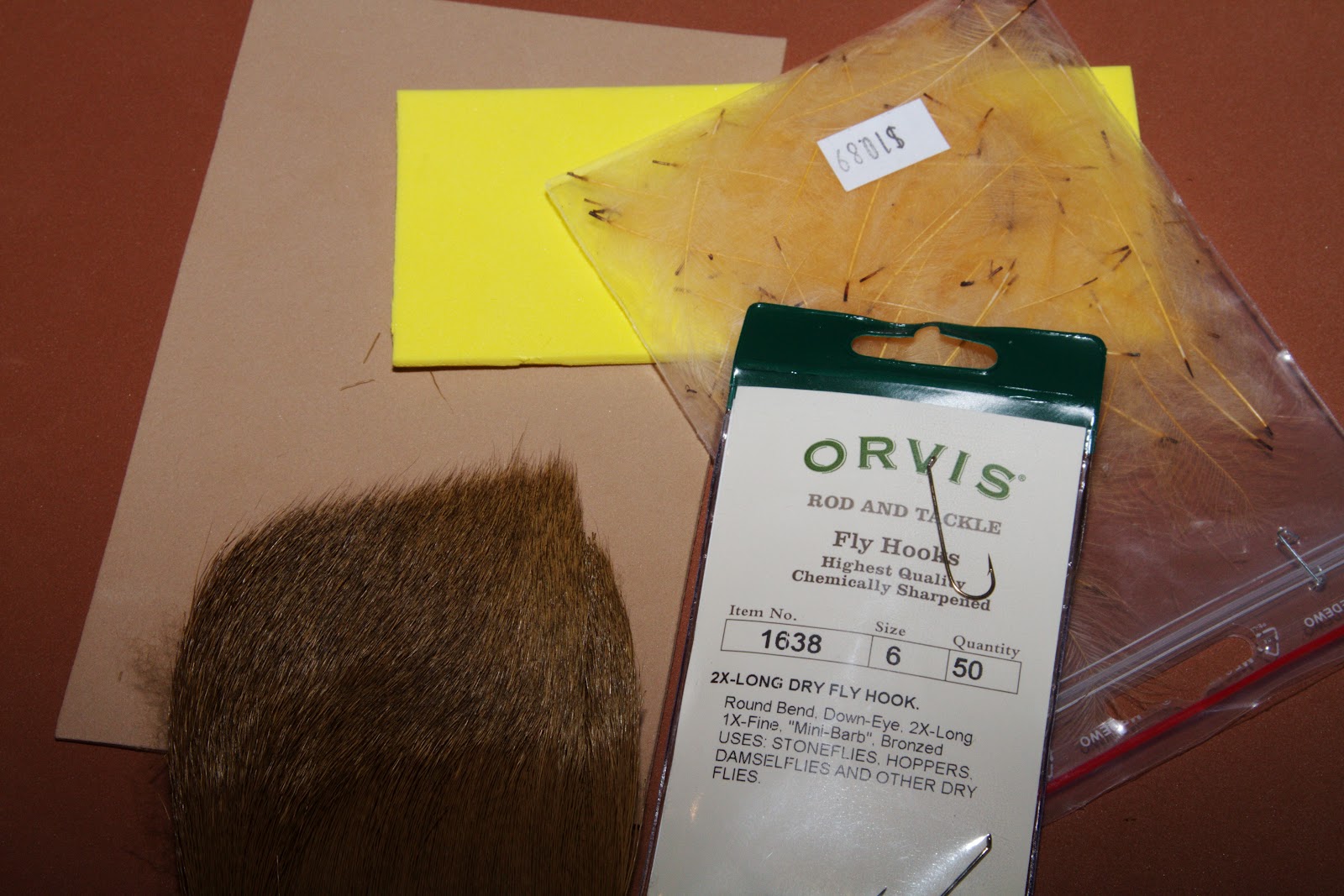


Materials Used
Pictured above are the materials used for this fly.  The tan and yellow foam can be purchased from your local hobby store in large sheets for about $.90. You can buy CDC feathers from your local fly shop (Top quality CDC is not necessary). I would suggest buying good deer hair as it will make it easier to tie down and trim.


Step 1.  Add body foam strip to hook as shown

 Cut a strip of foam for the body about 3 - 4 inches long and a little wider than 1/8".  Then in the center (length wise and width wise) insert the hook as shown above. Add a base of  6.0 thread.


Step 2. create the first segment


You will create the first of 5 equal size sections of the segemented hopper body by lining up the foam strip along the top and botton of the hook and bind down with 3 or 4 thread wraps. Then add glue to the exposed threads along the hook shank. This will help prevent the finished fly from twisting.


Step 3. Finish the segmented body
The body should have 5 distinct segments. This is accomplished by after tying a segment, you pull the foam strips back and advance the thread on the hook shank then pull the foam back over the hook shank and bind it down with 3 or 4 wraps. Try to keep all segments the same size. Trim off the excess behind the hook eye and bind down with thread wraps.


Step 4. Add CDC Under Wing
After you have bound down the foam behind the hook eye, draw the thread behind the first body segment as shown and make two wraps. Then add two CDC feathers extending about 1/4" beyond the body. Place them one on top of the other and secure with 3 thread wraps and trim butt ends.


Step 5 and 6.  Add the Deer Hair Overwing and Legs

If you have good quality deer hair there is no need to stack. Just cut off a section of hair, comb out under fur and position it on top of the hook with the tips extending just past the CDC. Bind down using the pinch. Make sure you keep all deer hair on top of the hook. I like to add cement to the butts of the deer hair on top of the hook shank. This will hold the hair in place and make the fly more durable.
 Add the rubber legs on both sides. Note: on this fly I used two strands of rubber legs and knotted them, then cut one of the strands below the knot to give a tapered appearance.


Step 7. Add the Yellow Foam to be used for the Bullet Head

Just behind the hook eye tie down the foam to be used for the head and indicator. Trim excess and cover with thread wraps. 


Step 8. Cover thread wraps with dubbing
Add dubbing to thread and try to keep it as tight as you can. Cover the thread wraps behind the hook eye. After covering the thread wraps, move the bare thread to just behind the first segment in preparation to add the front legs.


Step 9. Add the Front Legs

Front legs can be the same or a different color than the back legs.  Get creative here.


Step 10. Form the Foam Bullet Head
Pull and stretch the foam up over the first segment and bind down with two or three wraps. Cut leaving about 1/4" beyond the first segment and trim to shape as shown.  Then add a whip finish and glue.


Finally The Finished Fly


You can use a sharpie to color the legs
 

Experiment with different colors of foam bodies, legs, bullet heads and indicators. The one we tied today with the yellow bullet head is an ideal fly for  poor light or rough water conditions in that it is much more visable to the fly fisher.  


Some Variations


Check back next week for another of quick "guide fly" pattern that I use to fool our trout. Good fishing to all of you and get out and get a couple with this fly.

Scott McClintock

Monday, January 10, 2011

Asian Carp Invasion --- Great Lakes are in trouble

ASIAN CARP another Threat to our Great Lakes Ecosystem
Asian Carp were brought to this country to keep the Algae under control in the catfish farms in our southern states. Eventually due to floods the Asian Carp washed out and entered the Mississippi River becoming a major threat to our Ecosystem. These fish have over run the river and are now as far north as Chicago. It is said that in some sections in the Midwest that these fish make up 90% of the biomass. Being voracious eaters they can grow from 60 to 100lbs. These fish can consume food (up to 40% of their body weight) that was there to support the existing aquatic life and greatly impact our Great Lakes Ecosystem. You may have seen these fish on television. They are the ones that leap out of the water at the sound of approaching boats. Broken noses have been reported from being hit by a carp while boating.

The Carp have migrated up the Mississippi and Lake Michigan is about to be invaded by these fish. An electronic barrier has been installed in the Chicago shipping canal, but reports are that there has been a breech of this barrier. Scientists fear that the carp could decimate the $7 billion sport fishing industry on the Great Lakes as well as permanently damage the ecosystem.

I am calling on all of you sport fishing folks to get educated on this and prepare for a battle. The reason should simply be to protect our Ecosystem, but if that doesn't get you going how about a $7 billion dollar deficit to our economy due to a decline in our sport fishery. Contact your local Trout Unlimited Chapter for more info. They will be glad to fill you in.

The Army Corps of Engineers are holding "town meetings" to review what should be done in the short and long term. Your voice is needed. For those of you in the Cleveland area it will be held in the Great Lakes Science Center January 13, 2011 2 to 8pm. In Cincinnati it will be at the Tangeman University Center Tuesday, February 1, 2011 2 to 8pm.
Important You must preregister in order for you voice to be heard. Also, if you can't attend one of these you can submit your comments on Army Corps site.


Thursday, December 30, 2010

Fall Season at an End

Check out our Delaware blog for a little teaser on winter Browns. Click on the Delaware link above, but be sure to return for our Fall season update.
It appears our fall season has fallen to Ice over. You can see from the picture at the bottom of the blog that we may be done fishing for awhile. That being the case, it's time to crank up our fly vices and get restocked.
Coming soon will be Fly Tying Tutorials on tying some of the proven flies below. We'll start with Steelhead flies to help get you ready for the spring run, then move to trout flies that have been proven on many trout streams across the country. Our intent is to help give you the basics on tying some excellent patterns that really work.
Pictured below are some of the flies that will appear in our upcoming blogs.
 Iceman Minnow


Some of my favorite trout flies


RSM Streamers and Good Trout Flies for Montana


Some Interesting Artifacts


Icey Conditions, but Still Beautiful

Thursday, December 9, 2010

Stream conditions - 12/9/2010 Things are looking up!

Winter is now upon us and Brett McCrae (SAO Guide) and I got a chance to get out and do some fishing yesterday. As you might guess we had it all to ourselves. I know most of you are thinking that we must be crazy, but it was productive. After fighting our way through blizzard conditions we arrived at Elk Creek where we encountered a lot of shelf ice, but very little slush. (Too cold for slush). We had to break out the shelf ice for about a half mile of river, but we found fish and yes we got into them. We actually had a great time in spite of the weather.
With reels and rod guides frozen solid it took a special technique to play these fish. Basically get ready to chase them. The other option is to have enough line out that you can play the fish by allowing the line to slip through your frozen fingers. Eventually, the fish is going to hit the reel and break off unless you are willing to give chase.
You can have a lot of fun out there during winter conditions. Make sure you are dressed properly (See http://rsmflyfishingguidedtrips.blogspot.com/ for proper clothing. ) to keep you warm and dry.
Be Safe. Ice covered rivers can present a major hazard if you are not familiar with the river and if you are not careful. As you know in our shale bottom rivers there are drop offs where you will get into trouble. Walking on an icy river is not a good idea and it is recommended that you hire a guide that is familiar with the river and cold weather fishing. A good guide can get you to the fish safely and provide you with opportunities to land your trophy.
So dress warm and be aware and use caution and get out and enjoy this beautiful time of the year.
.
Contact Steelhead Alley Outfitters (419)466-9382 for a safe, productive winter trip.
Feel free to give me a call to chat or to get a forecast on stream conditions.
Happy Holidays everyone,
Scott McClintock
Owner / Operator RSM Flyfishing
Lake Run Browns
I was asked to post some of the large browns that we had taken this year, so I picked these three for your viewing. We seem to be getting more browns this year than we did last year. Not sure where these bruisers came from, but the clients had almost as much fun catching them as I did netting them. The fish below, was caught by Chip Hutchings. I had to have my picture taken with it. Thanks to Chip Hutchings for the hookup.


The conditions are high and muddy for the Ohio Steelhead streams. They were getting fishable, but with the rain we've had, deer hunting is a better option. Depending on this blast of rain and snow we are getting, Ohio may be blown out for awhile. The good news is that we are all hoping for some fish to run into our Ohio tributaries.

Elk Creek was tricky on the 28th. The water conditions were near perfect in flow and color, but the water temp was cold. We managed a few fish, but they are mostly in the runs and pockets. Pools were not productive. The 29th was a stellar day as you can see on the steelhead blog. With all the recent rains, give Elk a few days to settle down, but keep your eye on the weather and the gages.

TIP: After the rain settles down and the streams begin to drop, hit the streams with big streamers while they are still off color.

See our Steelhead Stream reports blog for detailed fishing reports. Just use the nav bar above. More pics and stories to be posted soon.

Contact: Greg Senyo at Steelhead Alley Outfitters (419)466-9382 to book a trip or give me a call Scott McClintock at (330) 732-7057

Big Fish to you,
Scott McClintock

RSM Fly Fishing